
The Scale Lies.Your Body Composition Tells the Truth.
Two people can weigh the same and be completely different inside. Explore what body composition analysis (InBody and Seca) measures and why fat, muscle, visceral fat, water, and metabolism matter more than a single number.
Included in your weight-loss program
An InBody/SECA body composition scan is part of your Full Weight Loss Visit and every Follow-Up Visit.
A smarter way to track progress
Your provider uses your body composition trends to guide your nutrition, set protein goals, schedule follow-up timing, discuss medication when appropriate, and design your maintenance plan. It turns weight loss from guesswork into something you can actually see.
See the ProgramBaseline to follow-up
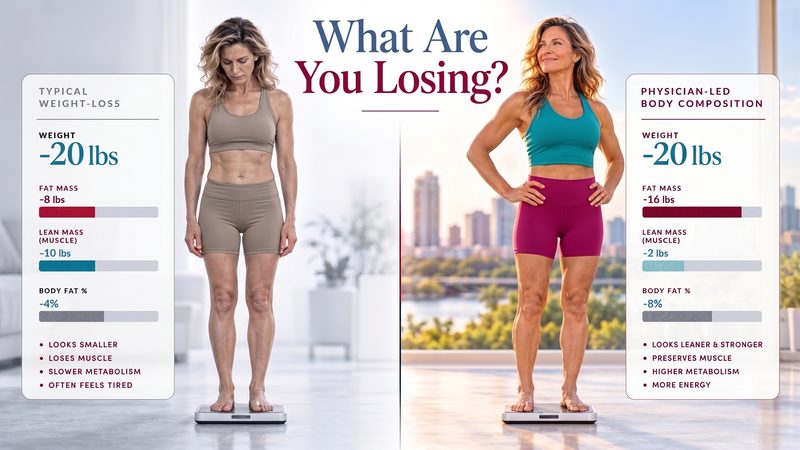
Same weight, different bodies
The scale gives one number. Body composition shows what that number is actually made of. Toggle the views below.
The scale says these two patients are identical. It cannot see fat, muscle, visceral fat, or hydration, so it cannot tell you whether you are making healthy progress.
Body composition analysis reveals the difference the scale hides, so your plan can target fat while protecting muscle.
Quick health calculators
These give you a rough starting point. A body composition analysis at Clinic 45 shows what these estimates cannot: how much of your weight is fat, and how much is muscle.
These calculators are educational tools, not a diagnosis or a substitute for medical care at Clinic 45.
Tap each metric to learn more
Muscle (Lean Mass)
Lean muscle burns more energy at rest than fat, so protecting it helps support your metabolism.
During weight loss, especially rapid weight loss, some muscle can be lost along with fat. That can slow metabolism and make regain easier.
We want the scale to drop because fat is going down, while muscle stays protected.
Body Fat
Body fat percentage gives a clearer picture than weight alone. Two people at the same weight can have very different fat and muscle levels.
The goal of a healthy program is to reduce fat while protecting lean mass, not just to see a smaller number.
Tracking fat percentage shows whether your progress is the right kind of progress.
Visceral Fat
Visceral fat is stored deep around your abdominal organs, unlike the fat just under the skin.
Higher visceral fat is associated with metabolic risk, including links to insulin resistance and fatty liver. It is one of the most useful trends to watch.
Reducing visceral fat is often one of the most meaningful metabolic wins.
Body Water
Body water reflects hydration and can shift day to day with food, salt, hormones, and activity.
Because water shifts quickly, daily scale swings are often water, not fat. That is one reason the scale alone can be misleading.
Understanding water helps you not panic over a one-day change on the scale.
Basal Metabolic Rate
Your basal metabolic rate (BMR) is roughly the energy your body uses at rest to keep you alive.
More lean mass generally supports a higher BMR. Protecting muscle during weight loss helps support your metabolism for the long run.
A metabolism-aware plan protects the engine that helps keep weight off.
Progress Tracking
Repeating your analysis over time shows trends: fat down, lean mass protected, visceral fat improving.
Trends tell a better story than any single measurement, and help your provider adjust your plan intelligently.
Progress is a direction over time, not a single number on a single day.
Body composition FAQs
Is body composition analysis a diagnosis?
No. It is a supportive measurement tool used to guide and track your care plan.
How is it different from BMI?
BMI is based only on height and weight. Body composition analysis looks at fat, lean mass, visceral fat, and hydration, giving a much clearer picture.
How often should I repeat it?
Many patients benefit from checking trends during follow-up visits. Your provider will recommend timing for your program.
Why did the scale go up but I look leaner?
Daily weight can shift with water, food, and hormones. Body composition trends over time tell the real story.
Start with a baseline analysis
See what your weight is really made of, and track the progress that counts.